.avif)

Learn to identify bats this summer. Practical guide to their flight types, habitats and how to recognize them on your vacation.
We imagine you on the sun lounger by the pool at nightfall. Or taking a relaxing walk on the beach or in the mountains. Now is the time to do your first bat study. It is at this time that these wonderful mammals hovering above you should not go unnoticed. Either looking for food, going to your pool or a nearby lake to drink. These are good times to try to introduce your friends and especially the youngest members of the house to the species (or at least the genera) of bats that live with us and that rid us of annoying mosquitoes.
Although this is not an easy task, we are going to review some guidelines to help us identify Our bats.
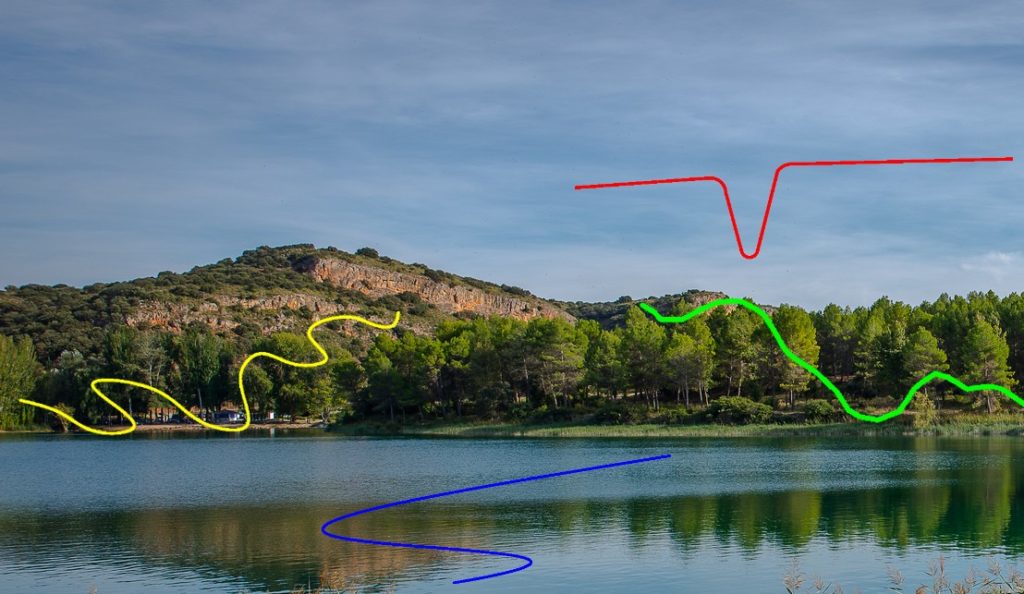
The flight of the little ones, the “Pipis”
The most abundant (by our latitudes). The so-called “Pipis” because they belong to the genus Bats.
These are the ones we usually see in the countryside and in our cities at dusk, even when the light is still on. In this group; the Common bat, the of clear border or The one from Cabrera are the most common in our latitudes. They do not maintain a fixed height or course. They fly erratically and like to border vegetation, buildings and streetlights, and it's easy to see them following tree lines.

Bats on the water
Although we can detect all species on sheets of water (swimming pools, lakes, etc.), the most classic due to its slow flight over water is the riverine bat (Myotis daubentonii), which usually feeds on sheets of water or watercourses, just 10 cm from the surface, almost touching the water with the tips of its wings. It is a hunting flight that is quite similar to that of a small waders called Andarríos Chico (Actitis hypoleucos). In this way, it captures, with its legs and the uropatagium (elastic membrane in which the tail is inserted and located between the hind legs), small insects and other invertebrates found on the surface.

The Great Flying Ones
Without considering the flying foxes that do not inhabit our lands, noctules and rabudos are the best flyers. The former usually fly over trees and at high altitude; in addition, they leave their shelters very early at dusk, so that they can meet swifts or swallows in the air. Tabudos have a higher flight speed, thanks to their long and narrow wings, suitable for fast flight and hunting in open spaces. Both perform “falcon” hunting bites in search of their favorite prey: flying beetles (beetles) and large moths. As a curiosity, the giant noctule (Nyctalus lasiopterus) also tends to prey on small birds that migrate at night to high altitudes.

The ears
They usually leave their shelters after dark, and they usually fly very close to trees, making them more difficult to detect. Their flight is more similar to that of butterflies, slow and “floating”

Look up at the sky this summer, watch the bats fly and tell everyone about it.
The explanation for everything
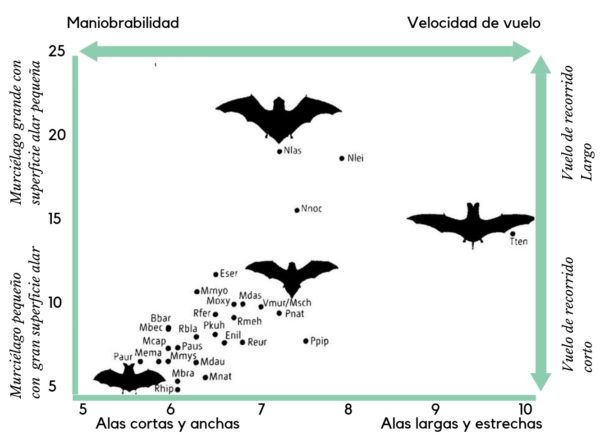
It is known that the morphology of the wings in bats is relevant to the form of flight and is therefore related to feeding and behavioral behaviors. Thus, bats that feed in open spaces usually have long wings to carry larger prey (noctules, tails,...). On the other hand, bats that feed among vegetation or close to buildings tend to have short wings and therefore greater maneuverability.
In the following figure we show you an illustration that relates these variables in relation to the different species of European bats for your study of bats.

.avif)